JOURNAL
Shilajit: Evidence, Standardization and Contamination Risks
Shilajit is a sticky, tar-like substance that oozes from mountain rocks, prized for centuries in Ayurvedic medicine and now sold as an energy-and-testosterone "superfood." It's genuinely interesting — and genuinely tricky, because the same natural origin…
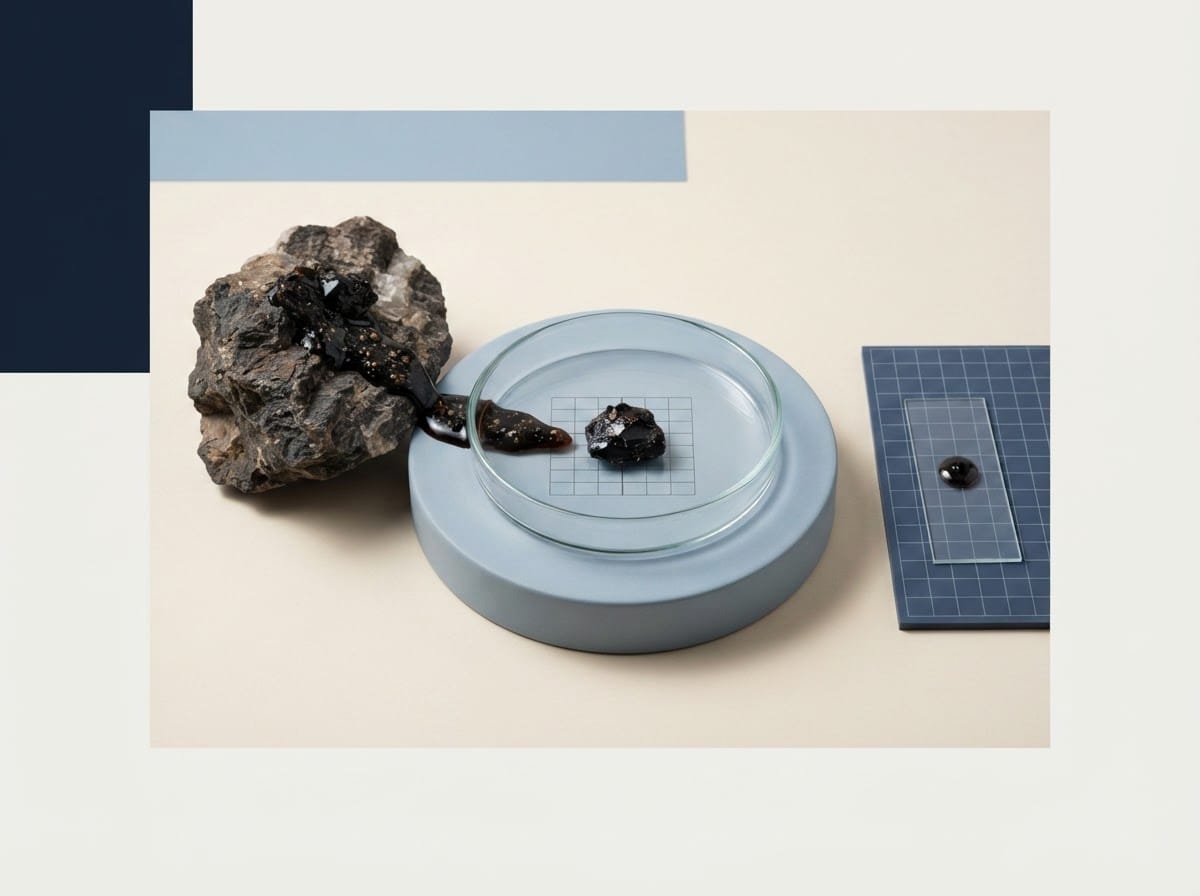
Shilajit is a sticky, tar-like substance that oozes from mountain rocks, prized for centuries in Ayurvedic medicine and now sold as an energy-and-testosterone "superfood." It's genuinely interesting — and genuinely tricky, because the same natural origin that gives it its mineral content also makes contamination and standardization its two defining problems. Here's the grounded picture.
Key takeaways
- Shilajit is a natural exudate rich in fulvic acid and minerals, used traditionally as a rasayana (rejuvenator) in Ayurveda.
- Human evidence is limited and small: a couple of testosterone trials, some fertility and fatigue studies — mostly small, short, and not definitive.
- Because it forms in rock over long periods, raw shilajit can contain heavy metals (lead, mercury, arsenic, cadmium, even thallium). Purification and testing are essential, not optional.
- Its composition varies enormously by source, which is why standardization (usually to % fulvic acid) and third-party testing matter so much.
- It's not a proven testosterone "booster." Treat it as a traditional supplement with early evidence — and real quality risks.
What it is
Shilajit is a blackish-brown, resin-like material that seeps from rocks in mountain ranges like the Himalayas over centuries, formed from the slow decomposition of plant and microbial matter. Its most-discussed active component is fulvic acid, along with a broad mix of minerals and trace elements.
That origin story is the key to everything that follows. Shilajit isn't manufactured to a spec — it's a natural geological product, so what's in it depends heavily on where and how it formed and how (or whether) it was purified.
What the evidence actually shows
Shilajit has a long traditional pedigree, but modern human research is thin. Here's the honest scorecard by claim.
Testosterone
This is the headline claim, and it rests on very little. The most-cited study is a 2016 randomized, double-blind, placebo-controlled trial in healthy men aged 45–55, using purified shilajit 250 mg twice daily for 90 days. It reported significant increases in total testosterone, free testosterone, and DHEAS versus placebo, while LH and FSH stayed stable.
Sounds promising — but read the fine print: only around three dozen men took shilajit, the study was short, and it measured testosterone with methods not considered the most reliable. One small trial is a starting point, not proof. Independent reviewers rate the human testosterone evidence as weak and at high risk of bias.
Fertility, fatigue, and lipids
- A small study in men with low sperm counts (200 mg purified shilajit, ~55% fulvic acid, 90 days) reported improved sperm parameters.
- Small studies have explored fatigue/exercise and cholesterol, with modest reported effects.
Across the board these are small, preliminary studies. Much of shilajit's touted mechanism traces back to fulvic acid activity in test tubes, which — as reviewers repeatedly note — doesn't automatically translate to benefits in the human body.
Fair summary: interesting traditional compound, a few encouraging small trials (notably one short testosterone study), but nowhere near the evidence base to call it a proven testosterone or energy booster.
The two problems that define shilajit
This is where shilajit differs from most supplement ingredients — the risks are baked into its nature.
1. Heavy-metal contamination
Because it forms in rock, shilajit can naturally carry heavy metals: lead, mercury, arsenic, cadmium, and even thallium have been documented in commercial products. Reviews stress that raw, unpurified shilajit is not safe to consume — some samples exceed permissible metal limits, and a 2025 analysis specifically detected thallium in commercial shilajit supplements.
The implication is stark: with shilajit, "raw" and "natural" are warning signs, not selling points. Proper purification and batch-level heavy-metal testing are the difference between a supplement and a slow toxic exposure.
2. Standardization and variability
Shilajit's composition swings widely with altitude, climate, and local geology. Without standardization you don't actually know how much fulvic acid — or how much lead — you're getting. Quality products are standardized to a stated fulvic acid content and come with a certificate of analysis. Everything sold as an unlabeled "pure Himalayan resin" with no testing is a gamble.
The bottom line
Shilajit is a fascinating traditional substance with a genuinely interesting fulvic-acid-and-mineral profile — and a thin, early human evidence base that does not justify "guaranteed testosterone boost" marketing. Its defining issues are quality issues: heavy-metal contamination and wild source-to-source variability. If you use it at all, the single most important decision is buying a purified, standardized, third-party-tested product — with shilajit, sourcing isn't a detail, it's the whole safety story.
Sources
- Pandit S, et al. Clinical evaluation of purified shilajit on testosterone levels in healthy volunteers. Andrologia, 2016.
- Hazardous or advantageous: heavy metals and humic substances in shilajit. 2024.
- Quantifying thallium in shilajit and its supplements. BMC Chemistry, 2025.
- Operation Supplement Safety (US DoD). Shilajit as a dietary supplement ingredient.
- Carrasco-Gallardo C, et al. Shilajit: a natural phytocomplex with potential procognitive activity. 2012.