JOURNAL
How to Read a Supplement Label
A supplement label is a small legal document dressed up as marketing. Once you know which parts are regulated fact and which are free-form persuasion, you can read a bottle in about thirty seconds and know whether it deserves your money. Here's how.
A supplement label is a small legal document dressed up as marketing. Once you know which parts are regulated fact and which are free-form persuasion, you can read a bottle in about thirty seconds and know whether it deserves your money. Here's how.
Key takeaways
- The Supplement Facts panel is the regulated, factual part of the label. The front of the bottle is marketing. Read the back first.
- Serving size is the lever brands use to make a dose look bigger or smaller than it is. Always check how many capsules make one serving.
- For minerals, look for the elemental amount — the actual mineral — not just the compound weight.
- "Proprietary blend" means you're told the total but not the individual doses. That's a transparency red flag, not a trade secret worth protecting.
- %DV tells you how a nutrient compares to general daily needs; ingredients with no established %DV simply show the amount.
Start at the back, not the front
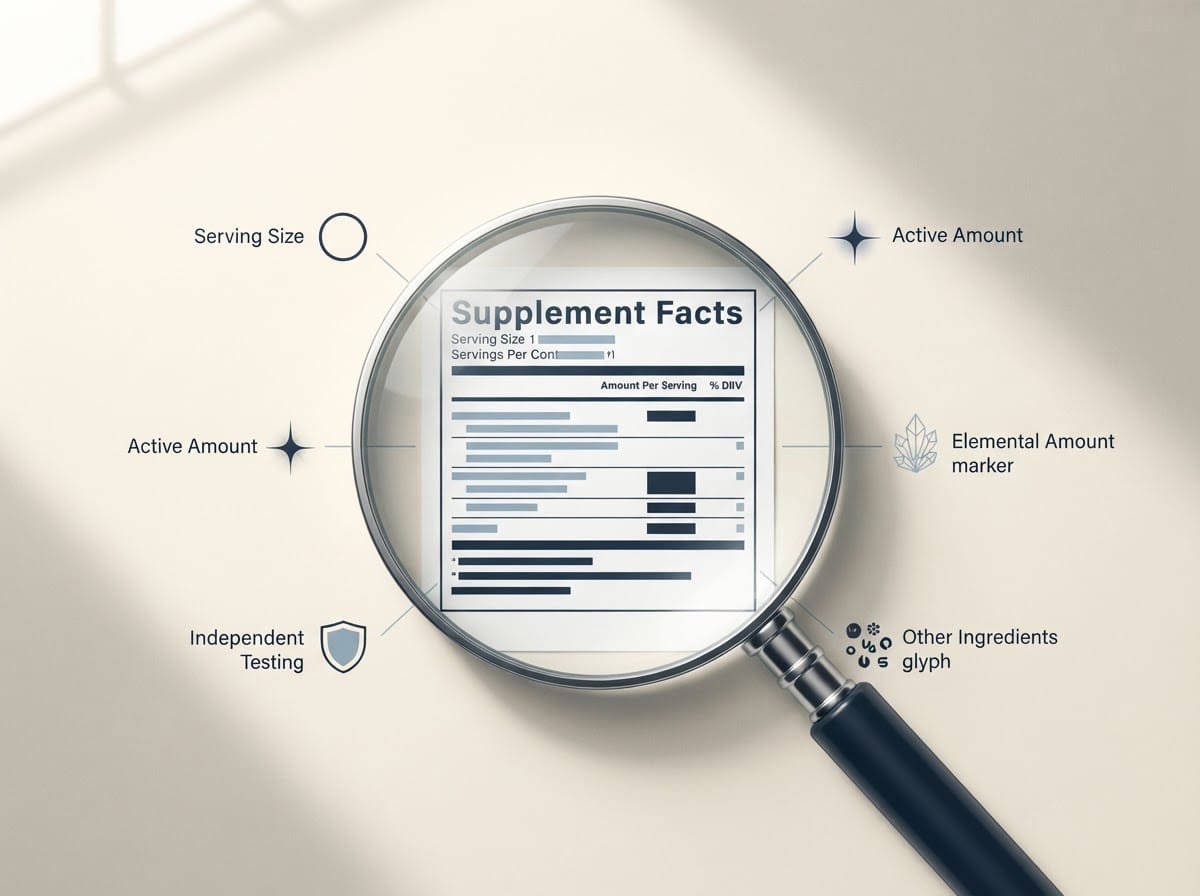
The front label exists to sell you. "Advanced," "clinical-grade," "maximum strength" — none of those words are defined or regulated. Flip the bottle over. The Supplement Facts panel is where the FDA requires real, standardized information: serving size, servings per container, each ingredient, the amount per serving, and the % Daily Value where one exists.
If a product's story is all on the front and the back is vague, that tells you something before you've read a single number.
The five things worth checking
1. Serving size (the most-gamed number)
Everything on the panel is "per serving" — and the brand decides what a serving is. A bottle might advertise "1,000 mg" but define a serving as three capsules. Suddenly "90 capsules" is a 30-day supply, and the per-capsule dose is a third of what you assumed. Always translate the panel into "per capsule" and "how long will this bottle actually last."
2. Elemental amount (for minerals)
Minerals are bound to a carrier — magnesium glycinate, zinc picolinate, iron bisglycinate. The compound weighs more than the mineral inside it. A good label lists the elemental amount: "Magnesium (as magnesium bisglycinate) — 200 mg." If it only shows the compound weight, you can't actually tell how much mineral you're getting.
3. % Daily Value (%DV)
%DV compares the amount in a serving to a general daily reference intake. It's a quick way to see whether a dose is trivial or substantial — 200% DV means double the reference amount. Note that many popular ingredients (herbs, botanicals, things like CoQ10) have no established %DV, so the panel just lists the amount in milligrams. That's normal, not suspicious.
4. The "proprietary blend" trap
If you see "Proprietary Blend — 500 mg" followed by a list of ingredients with no individual amounts, be cautious. Legally, a brand can disclose only the blend's total weight and the order of ingredients (by weight), hiding how much of each you're getting. That lets a product look loaded with premium ingredients while containing only a pinch of the expensive ones — a technique sometimes called "fairy dusting." Transparent brands print every dose.
5. The "Other ingredients" line
Below the panel is a line for everything that isn't an active ingredient: capsule material, fillers, flow agents, colors, sweeteners. This is where you'll spot things you might want to avoid — artificial colors, unnecessary binders — or confirm a product is vegan or allergen-free.
A 30-second label scan
What the label can't tell you
A label proves what's declared, not what's actually in the capsule — that's what independent testing is for (a separate topic we cover on its own). And no label, however honest, tells you whether you personally need the product. Those two gaps are exactly where a skeptical reader stays skeptical.
The bottom line
Read the back before the front. Translate everything into per-capsule reality, insist on seeing actual doses instead of blends, and check the elemental amount for minerals. A brand that makes all of that easy to find is telling you something about how it treats you — and so is one that doesn't.
Sources
- US Food & Drug Administration. Dietary Supplement Labeling Guide.
- US Food & Drug Administration. How to read the Supplement Facts label.
- National Institutes of Health, Office of Dietary Supplements. Dietary supplements: what you need to know.
- US Federal Trade Commission. Health Products Compliance Guidance. 2023.