JOURNAL
A Better Evening Wind-Down, Without the Hacks
Most "perfect night routine" advice online is either a 12-step ritual you'll quit by Thursday or a list of gadgets to buy. This is the opposite: a short, evidence-informed wind-down built around the few things that actually move the needle — and honest…
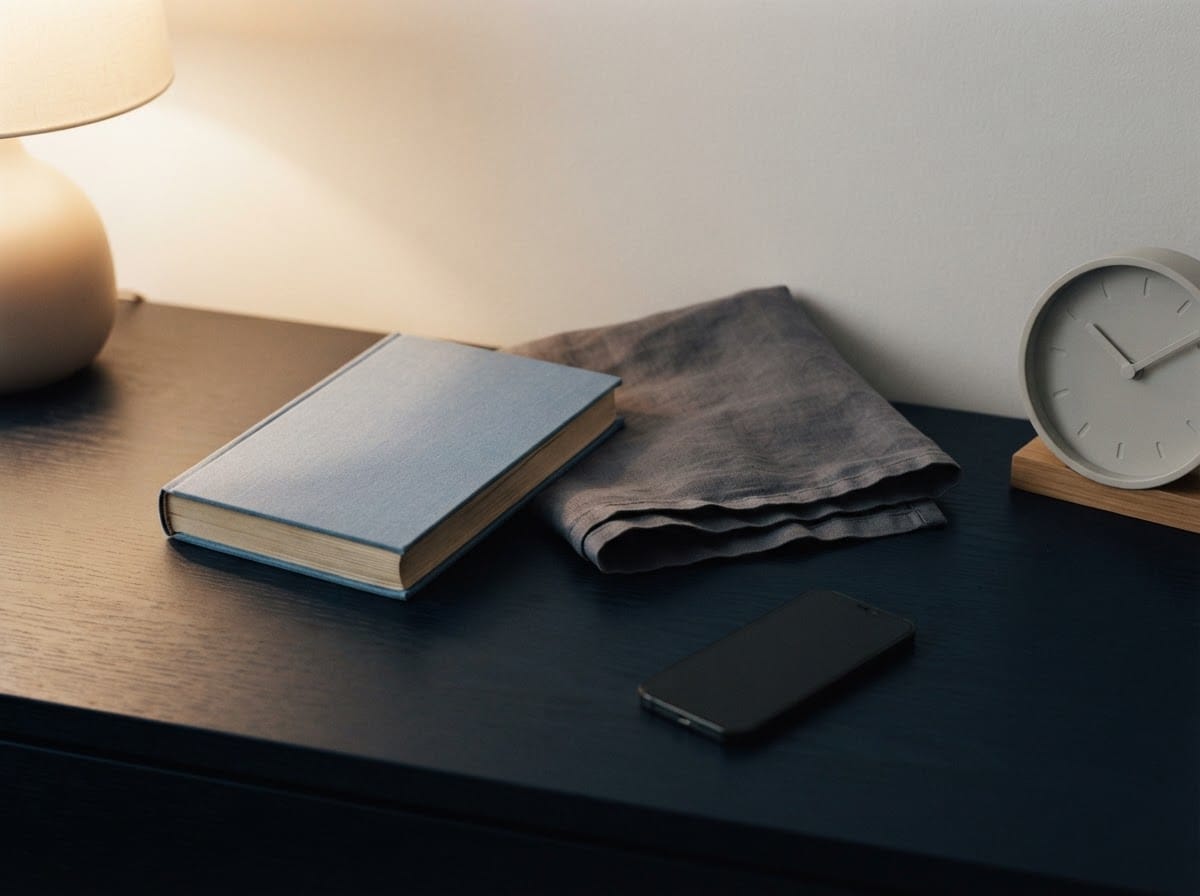
Most "perfect night routine" advice online is either a 12-step ritual you'll quit by Thursday or a list of gadgets to buy. This is the opposite: a short, evidence-informed wind-down built around the few things that actually move the needle — and honest about the fact that consistency beats novelty every time.
Key takeaways
- The single most reliable lever is a consistent sleep and wake time, even on weekends. Routine, not any one trick, is what the evidence keeps pointing back to.
- Caffeine lingers far longer than people think. In a controlled trial, caffeine taken 6 hours before bed still measurably cut sleep — a good reason to set an early-afternoon cutoff.
- Bright screens in the 1.5–2 hours before bed can blunt your natural evening melatonin rise and make you feel less sleepy. Dimming and stepping back genuinely helps.
- A "wind-down window" works because it lets your body shift out of alert, problem-solving mode — not because of any single product.
- No supplement or device replaces the basics. Build the routine first; add anything else on top of it, not instead of it.
Why a wind-down works at all
Sleep isn't a switch you flip; it's a landing you approach. Researchers describe an evening "winding-down window" — the stretch before bed when your brain transitions from wakefulness toward sleep. The whole point of a routine is to protect that window from the things that keep your nervous system revved up.
Chronic difficulty falling asleep is often tied to hyperarousal — a body that stays in go-mode when it should be powering down. You can't force sleep, but you can stop actively blocking it. That reframe matters: a good wind-down is mostly about removing interference, not adding rituals.
The routine, in order of what matters
1. Anchor your wake time (the highest-leverage habit)
If you do only one thing, do this. A regular schedule — especially a consistent wake time — is one of the most consistently supported sleep-hygiene practices. It stabilizes your body clock so that sleepiness arrives on schedule. Weekends included; a two-hour weekend shift is enough to leave you groggy Monday.
2. Set a caffeine cutoff
Caffeine's half-life means it's still in your system hours after your last cup. In a well-known randomized study, a 400 mg dose taken 0, 3, or even 6 hours before bed all disrupted sleep versus placebo — and 6-hours-before still cut total sleep time meaningfully. A meta-analysis found caffeine reduced total sleep time by around 45 minutes on average.
Practical rule: for most people, no meaningful caffeine after early-to-mid afternoon. If you're caffeine-sensitive or a slower metabolizer, push the cutoff earlier.
3. Dim the screens 1–2 hours out
Bright light in the evening — especially from screens held close to your face — suppresses melatonin, the hormone that signals "night" to your body. Research suggests about 1.5 hours of bright screen use in the evening is enough to blunt the natural melatonin rise and leave people feeling more alert.
You don't need to live like it's 1850. Practical version:
- Drop screen brightness and switch to night mode in the evening.
- Move the most stimulating stuff (work email, doomscrolling, intense games) out of the last hour.
- If you want a screen-free wind-down, reading, a warm shower, or light stretching are classic low-effort swaps.
4. Keep the last two hours low-arousal
The wind-down window is not the time for hard workouts, heavy financial planning, or solving a work crisis. Intense exercise late raises core temperature and stress hormones; intense thinking keeps your brain in problem-solving mode. Both make the landing harder. Shift toward passive, low-stakes activities.
5. Make the room boring for your brain and easy for your body
Cool, dark, quiet. A comfortable, slightly cool room and minimal light are standard for a reason. Keep the bedroom for sleep so your brain associates the space with winding down rather than working.
A realistic 60-minute template
You can compress or stretch this — the order matters more than the exact minutes.
What about supplements and gadgets?
They come last, on purpose. Something like magnesium may give a small nudge for some people, and we cover that evidence honestly in our explainer. But no capsule, ring, or lamp out-performs a stable schedule and a caffeine cutoff. If the foundation isn't there, you're buying accessories for a routine that doesn't exist yet.
⚠️
When to look beyond routine
Persistent trouble falling or staying asleep, loud snoring with daytime exhaustion, or sleep problems that last weeks despite good habits are worth raising with a clinician. A wind-down routine is general self-care, not a treatment for a sleep disorder.
The honest takeaway
A good evening routine isn't a stack of hacks — it's a short, repeatable sequence that removes the obvious blockers and lets sleep arrive on its own. Anchor your wake time, cut caffeine early, dim the screens, keep the last two hours calm. Do the boring version every night, and you'll out-sleep almost anyone chasing the next trick.
Sources
- Drake C, et al. Caffeine effects on sleep taken 0, 3, or 6 hours before going to bed. J Clin Sleep Med, 2013.
- Gardiner C, et al. The effect of caffeine on subsequent sleep: a systematic review and meta-analysis. Sleep Medicine Reviews, 2023.
- The influence of blue light on sleep, performance and wellbeing in young adults: a systematic review. 2022.
- Harvard Health. Sleep hygiene: simple practices for better rest.
- Winding down for sleep: how behavioral, cognitive, motivational, and emotional factors interact. Sleep Medicine Reviews, 2025.