JOURNAL
Does More Always Mean Better?
The question: A bottle boasts "mega-dose" or "10x strength." Is a bigger dose actually better — or just a bigger number on the label?
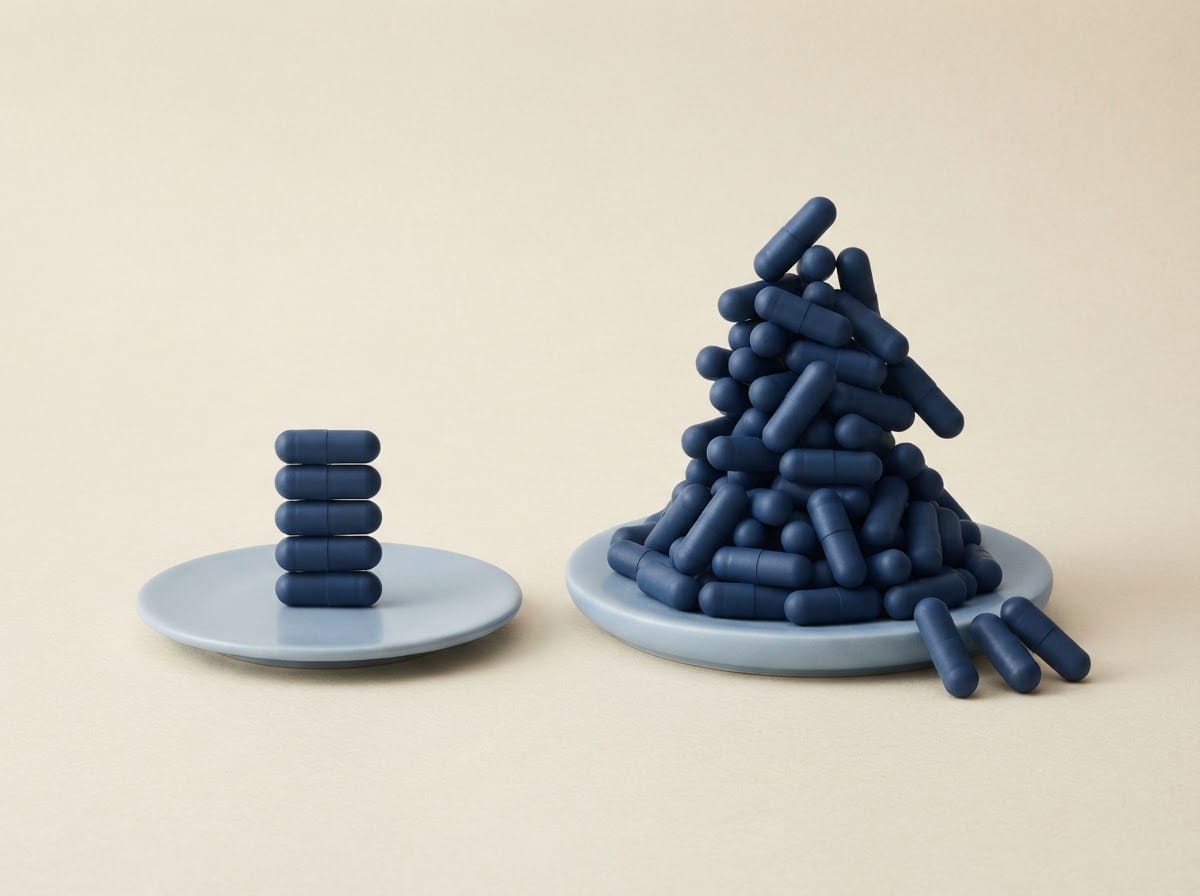
The question: A bottle boasts "mega-dose" or "10x strength." Is a bigger dose actually better — or just a bigger number on the label?
The short answer: Almost never. For most nutrients, benefit rises until you have enough and then flattens, while the risk of side effects keeps climbing. "More" usually buys you expensive urine at best and real harm at worst.
Key takeaways
- Most nutrients follow a plateau, not a straight line: once you've corrected a shortfall, extra doesn't add proportional benefit.
- Several vitamins and minerals have a Tolerable Upper Intake Level (UL) — a ceiling above which harm becomes more likely.
- Water-soluble vitamins (like C and most B's) are largely excreted in excess; fat-soluble ones (A, D, E, K) can accumulate and cause toxicity.
- "Mega-dose" and "high-potency" are marketing terms, not evidence that a higher amount does more for you.
Why "more" stops working
Think of a nutrient like water for a plant. Too little and it wilts; the right amount and it thrives; too much and it drowns. Bodies work similarly. If you're low in a nutrient, correcting that shortfall can produce a real, noticeable benefit. But once you're replete, adding more doesn't push the benefit higher — the curve flattens. Your body simply uses what it needs and deals with the rest.
For water-soluble vitamins, "dealing with the rest" often means excreting it. That's the origin of the old line about supplements producing "expensive urine": past a point, you're literally paying to flush the excess.
When "more" becomes harmful
The plateau is the good-news half. The bad-news half is that while benefit flattens, risk often keeps rising. That's why nutrition scientists define a Tolerable Upper Intake Level (UL) for many nutrients — the highest routine daily intake unlikely to cause harm.
A few illustrations of why the ceiling exists:
- Fat-soluble vitamins (A, D, E, K) can build up in the body. Chronically high vitamin A or D, for example, can cause genuine toxicity.
- Some minerals cause trouble well before dramatic toxicity: excess supplemental magnesium causes diarrhea; too much zinc can interfere with copper; too much iron is dangerous, especially for children.
- Even vitamin C, famously "harmless," causes GI upset in large doses.
The point isn't fear — it's that the dose-response curve has two sides, and the label's big number only ever brags about one of them.
So how much is "enough"?
That depends on the nutrient, your diet, and your individual situation — which is exactly why a single "more is better" rule fails. Practical principles:
- Aim to correct a shortfall, not to maximize a number.
- Respect the UL where one exists; more isn't a bonus once you're near the ceiling.
- Doses used in research are usually moderate and specific, not the biggest number a brand could fit on a label.
The takeaway
A bigger dose is a bigger number, not automatically a bigger benefit. For most nutrients the useful range is modest, the benefit plateaus once you're topped up, and the risks rise if you keep pushing. "Mega" belongs on the marketing, not in your regimen — aim for enough, not most.
Sources
- National Institutes of Health, Office of Dietary Supplements. Nutrient Recommendations: Dietary Reference Intakes and Tolerable Upper Intake Levels.
- National Institutes of Health, Office of Dietary Supplements. Dietary supplements: what you need to know.
- US Food & Drug Administration. Fortify your knowledge about vitamins.