JOURNAL
How to Compare Supplement Doses Without Getting Misled
Two bottles, two prices, two big numbers on the front — and no obvious way to tell which is the better deal or the better product. Comparing supplement doses is where most people get quietly misled, because brands compare apples to oranges on purpose.…
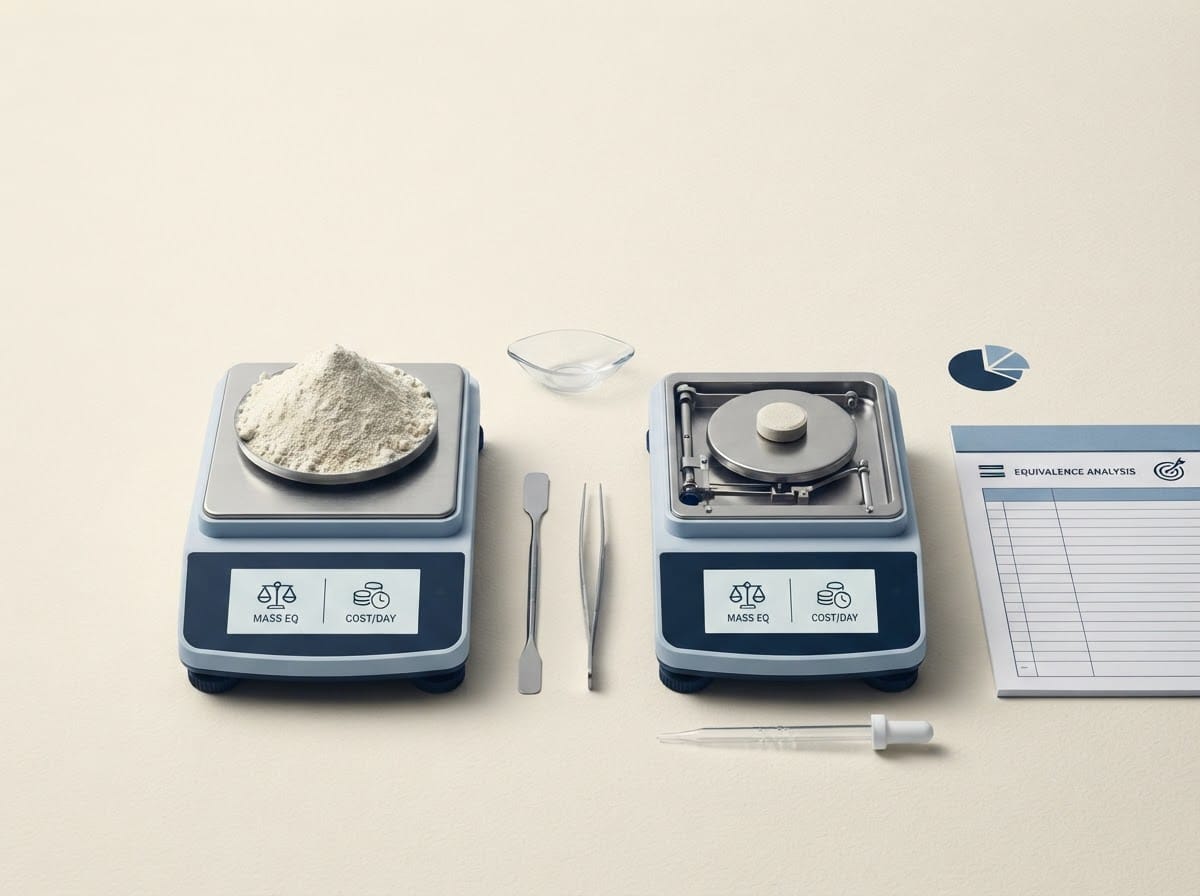
Two bottles, two prices, two big numbers on the front — and no obvious way to tell which is the better deal or the better product. Comparing supplement doses is where most people get quietly misled, because brands compare apples to oranges on purpose. Here's how to line them up fairly.
Key takeaways
- Always compare per serving and per day, then check how many pills a serving takes. The front-of-bottle number is often per multi-capsule serving.
- For minerals, compare elemental amounts, not compound weights — otherwise you're comparing different things.
- Standardized botanical extracts should be compared by their standardized active (e.g. % of a marker compound), not just total milligrams.
- Match the dose to what studies actually used — higher than the researched range is rarely a selling point.
- Compute cost per day at an equivalent dose, not price per bottle, to compare value honestly.
Step 1: Convert everything to "per day"
The serving size trick works because our eyes grab the biggest number. Bottle A says "2,000 mg," bottle B says "800 mg." But if A's serving is four capsules and B's is one, and the studied daily dose is ~800 mg, then B gives you the target in one pill while A makes you take four to reach 2,000 mg you may not even need.
Do this: find the amount per serving, note capsules per serving, and calculate the amount per single capsule and the total per day. Now the numbers are comparable.
Step 2: Compare like for like
Minerals: elemental, always
"500 mg magnesium citrate" and "500 mg magnesium glycinate" do not deliver the same magnesium. The compound weight includes the carrier. Find the elemental figure ("Magnesium — X mg") and compare those. If a label hides the elemental amount, you can't fairly compare it — treat that as a mark against it.
Botanical extracts: standardization matters
Herbal extracts are often standardized to a certain percentage of an active compound — for example, green tea extract standardized to a set % of EGCG, or an extract standardized to a marker like fulvic acid. "500 mg of extract standardized to 50%" delivers far more active than "500 mg of raw powder." Compare the standardized active, not the bulk weight.
Ratios and "equivalents"
Watch for "10:1 extract" or "equivalent to 5,000 mg of herb." These describe concentration or raw-herb equivalence, not the amount of active compound. They can be legitimate — but they're also easy to use to inflate a number. Anchor on the standardized active whenever one exists.
Step 3: Anchor to the researched dose
A bigger dose isn't automatically better (we cover why in a separate piece). The useful comparison isn't "which is highest" but "which lands in the range that studies actually used." A product far above the researched range isn't offering you a bonus — it may just be pushing past the point of added benefit, and closer to side effects.
Ask: what dose did the human research use? Then favor the product that hits that range cleanly — not the one flexing the largest figure.
Step 4: Compare cost the honest way
Price per bottle is meaningless if the bottles hold different doses and different counts. Normalize it:
Only after this step can you say one product is genuinely cheaper or better value than another.
A quick worked example
- Bottle A: "1,500 mg," serving = 3 capsules, 90 capsules, $30. → 30 servings, so $1.00/day for 1,500 mg (500 mg/capsule).
- Bottle B: "500 mg," serving = 1 capsule, 60 capsules, $24. → 60 servings, $0.40/day for 500 mg.
If the researched daily dose is ~500 mg, Bottle B is both the right dose and less than half the daily cost — despite the smaller front number. That's the whole game.
🧭
Rule of thumb. The product that makes it easy to do this math — clear per-capsule doses, elemental amounts, standardization — is usually the more honest one. Difficulty comparing is often the point.
The bottom line
Don't compare front-label numbers; compare per-day amounts of the thing that actually matters — elemental mineral or standardized active — against the dose research used, then normalize the price. It takes two minutes and routinely flips which product looks "stronger" or "cheaper."
Sources
- US Food & Drug Administration. Dietary Supplement Labeling Guide.
- National Institutes of Health, Office of Dietary Supplements. Dietary supplement fact sheets.
- US Federal Trade Commission. Health Products Compliance Guidance. 2023.